The Marketing Funnel: Stages, Strategies, & How to Optimize

Marketing Funnel: Stages, Strategies & How to Optimise It
In reality, a customer rarely discovers a business and immediately buys.
Instead, they may see an advertisement, ignore it, search for the problem later, read an article, compare several providers, watch a video, check reviews and return days or weeks later before finally making a decision.
As a result, that journey is what the marketing funnel helps businesses understand.
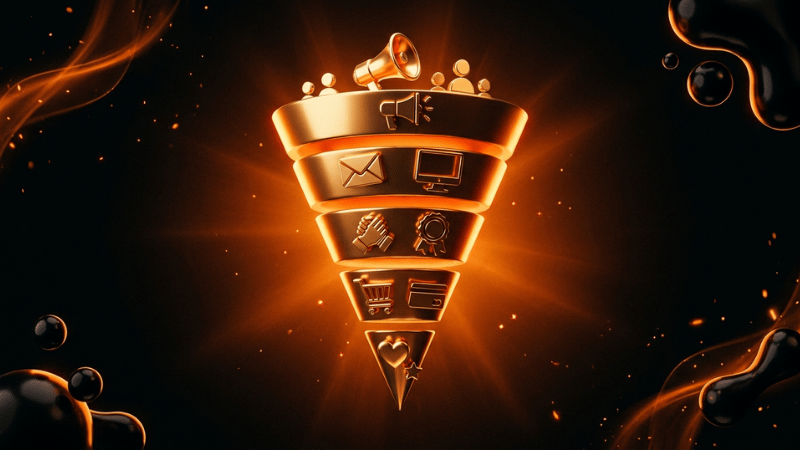
In simple terms, a marketing funnel is a framework that maps how potential customers move from first becoming aware of a brand or problem to considering a solution, taking action and potentially becoming loyal customers.
However, modern customer journeys are not perfectly linear.
In fact, someone may move backwards and forwards between stages.
For example, they may discover a brand through TikTok, compare it on Google, ask an AI assistant about the category, read customer reviews, return to Instagram and finally convert through a branded search.
Therefore, the purpose of a marketing funnel is not to assume every customer follows exactly the same path.
Instead, it helps businesses understand what potential customers need at different stages and which marketing activities can help move them closer to a decision.
Why the Marketing Funnel Matters for Singapore Businesses
For Singapore businesses, this matters because customer acquisition is increasingly distributed across multiple digital touchpoints. As people scroll, search, stream, compare and shop across platforms, businesses need more than isolated campaigns.
In other words, they need a connected marketing system.
For companies comparing the best digital marketing agency in Singapore, understanding the marketing funnel also provides a better way to evaluate strategy. After all, the question should not simply be whether an agency can generate clicks or impressions.
Instead, the more useful questions are:
- How are people discovering the brand?
- What happens after they become aware?
- Which information moves them towards consideration?
- What makes them enquire or purchase?
- How are customers handled after conversion?
- Which stages are losing the most potential customers?
With that in mind, this guide explains how a marketing funnel works, the main marketing funnel stages, strategies for each stage, the difference between marketing and conversion funnels, the metrics businesses should track and how to optimise the entire journey for sustainable growth.
What Is a Marketing Funnel?
In short, a marketing funnel is a framework used to represent the stages a potential customer moves through before and after making a purchase.
For example, a simple version looks like this:
Awareness → Interest → Consideration → Conversion → Retention → Advocacy
The funnel is usually wider at the top because many people may initially become aware of a business.
As customers move further down, however, the audience becomes smaller.
For example:
- 100,000 people see a campaign.
- 10,000 interact with the brand.
- 2,000 seriously consider the product.
- 500 enquire.
- 100 purchase.
Some then become repeat customers or advocates.
As a result, the narrowing shape is why the framework is called a funnel.
However, the numbers themselves are less important than the principle:
Not every person who discovers your business will, of course, become a customer.
Instead, your job is to improve how effectively relevant prospects move from one stage to the next.
Why the Traditional Marketing Funnel Is Still Useful
Admittedly, the traditional funnel has limitations.
For instance, modern customers do not always move neatly from awareness to consideration to purchase.
In fact, Google’s consumer-journey research increasingly describes customers as moving across activities such as streaming, scrolling, searching and shopping rather than following one predictable path.
In addition, businesses can explore this shift through Google’s discussion of modern customer journey mapping.
Even so, the marketing funnel remains useful as a planning framework.
In particular, it helps businesses answer three important questions:
- What does the customer need right now?
- Which marketing activity is most useful at this stage?
- What should the next action be?
However, without that framework, businesses often jump immediately to conversion.
For example, they show “Buy Now” or “Contact Us” messages to people who barely understand the brand.
In contrast, the marketing funnel encourages more appropriate communication.
What Are the Main Stages of a Marketing Funnel?
Of course, different models use different terminology.
For this guide, however, we will use six stages:
- Awareness
- Interest
- Consideration
- Conversion
- Retention
- Advocacy
| Stage | Customer Mindset | Marketing Objective |
|---|---|---|
| Awareness | “I have a problem or just discovered this brand.” | Gain relevant attention |
| Interest | “This might be relevant to me.” | Educate and build curiosity |
| Consideration | “Should I choose this solution?” | Build trust and preference |
| Conversion | “Am I ready to act?” | Reduce friction and drive action |
| Retention | “Should I continue buying?” | Increase customer value |
| Advocacy | “Would I recommend this?” | Generate referrals and loyalty |
As a result, each stage requires different messaging.
Stage 1: Awareness
First, awareness sits at the top of the marketing funnel.
In particular, this is where potential customers first become aware of:
- A problem
- Their own need
- A category
- Specific products
- A brand
For example, a business owner may notice that leads are becoming more expensive.
However, they may not yet be searching for a marketing agency.
Instead, they might search:
“why are Facebook leads getting expensive?”
In other words, that is an awareness-stage search.
Similarly, a parent may notice their child is struggling with mathematics but may not yet have decided whether tuition is necessary.
Therefore, the role of marketing at this stage is to connect the customer with a useful idea, problem or solution.
What Marketing Channels Work at the Awareness Stage?
Common top-of-funnel channels include:
- SEO
- Blog content
- TikTok
- Meta Ads
- YouTube
- Display advertising
- Podcasts
- Public relations
- Influencer content
- Organic social media
However, the goal is not necessarily immediate conversion.
Rather, it is relevant attention.
What Content Works at the Awareness Stage?
For example, useful content includes:
- Educational articles
- Explainer videos
- Industry insights
- Research
- Checklists
- Social posts
- Short-form video
For instance:
Instead of:
“Hire Our Marketing Company”
use:
“5 Reasons Your Lead Generation Campaign Is Producing Poor-Quality Enquiries”
The second message, in other words, meets the customer at the problem stage.
For this reason, a content marketing agency can help businesses develop this type of educational content around the questions customers actually search and ask.
Awareness Does Not Mean Reaching Everyone
One common marketing mistake is confusing reach with relevance.
For example, a campaign might generate one million impressions.
At first, that number sounds impressive.
But if almost none of those people could realistically become customers, the reach has limited business value.
Therefore, top-of-funnel marketing should focus on qualified awareness.
In particular, ask:
- Are we reaching the right category of person?
- Does the message match a real problem?
- Is the audience likely to need the solution eventually?
Ultimately, good awareness campaigns create future demand rather than meaningless visibility.
Stage 2: Interest
Next, after awareness comes interest.
At this point, the potential customer begins exploring.
For example, they may:
- Visit the website
- Follow a social account
- Read an article
- Watch multiple videos
- Sign up for a newsletter
- Search the category
At this stage, the customer is essentially asking:
“Could this be relevant to me?”
Therefore, the business needs to provide enough useful information to encourage further engagement.
What Content Works at the Interest Stage?
Useful formats include:
- Detailed blog articles
- Email newsletters
- Guides
- Video explainers
- Webinars
- Downloadable resources
- Case study introductions
For example, someone who becomes aware of SEO might next search:
“how SEO works”
or:
“is SEO worth it for small businesses?”
In fact, these are interest-stage questions.
Businesses can support this journey with educational resources such as OMNI’s guide on why SEO is important for businesses.
Stage 3: Consideration
At the consideration stage, the customer becomes more commercially serious.
By now, they understand the problem.
In addition, they know possible solutions exist.
As a result, they are now comparing options.
For example, typical searches may include:
- best digital marketing agency Singapore
- SEO vs Google Ads
- agency vs in-house marketing
- digital marketing pricing
- lead generation agency Singapore
- best tuition centre near me
As a result, this is where trust becomes critical.
In short, the prospect wants evidence.
What Customers Need During Consideration
For instance, they may want to know:
- How does the service work?
- What results can I expect?
- How much does it cost?
- Who have you worked with?
- Why should I choose you?
- What makes your approach different?
- Which risks are involved?
Businesses that hide this information may therefore create unnecessary uncertainty.
What Content Works at the Consideration Stage?
Useful formats include:
- Case studies
- Testimonials
- Comparison pages
- Pricing guides
- Product demonstrations
- Webinars
- Service pages
- FAQs
- Reviews
For example, a prospect comparing SEO providers may find a detailed guide to SEO cost in Singapore more useful than a vague statement telling them to “contact us for pricing”.
After all, transparency supports trust.
Stage 4: Conversion
Next, conversion is where the prospect takes the desired action.
Naturally, that action depends on the business.
Examples include:
- Purchase
- Contact form submission
- WhatsApp enquiry
- Trial registration
- Consultation booking
- Product demo request
- Subscription
- Appointment
At this stage, the marketing funnel becomes closely connected to conversion optimisation.
For instance, a prospect may already trust the business but still fail to act because the experience creates friction.
Common Conversion Barriers
These include:
- Confusing forms
- Weak calls-to-action
- Unclear pricing
- Slow websites
- Poor mobile experience
- Lack of trust signals
- Complicated checkout
- Too many decisions
- Unclear next steps
For example, businesses wanting a deeper breakdown can explore OMNI’s guide to building and improving a conversion funnel.
Ultimately, the key principle is simple:
In other words, do not make conversion harder than necessary.
Stage 5: Retention
Many businesses stop thinking about the marketing funnel once a purchase happens.
However, that can be expensive.
After all, acquiring a new customer often requires:
- Advertising
- Content
- Sales time
- Discounts
- Promotions
In contrast, an existing customer already knows the business.
Therefore, retention can improve profitability significantly.
For example, retention strategies may include:
- Email marketing
- Loyalty programmes
- Customer support
- Upsells
- Cross-sells
- Renewal campaigns
- Customer education
As a result, the objective changes.
Instead of asking:
“How do we get the first sale?”
the business asks:
“How do we increase the value of the relationship?”
Stage 6: Advocacy
Finally, the last stage is advocacy.
In fact, satisfied customers can become a marketing channel.
For example, they may:
- Leave reviews
- Refer friends
- Recommend the brand
- Share products
- Participate in testimonials
- Create user-generated content
For many businesses, referrals can become extremely valuable because they arrive with existing trust.
For instance, a referred prospect may already believe the business is credible before speaking with sales.
Therefore, customer experience after the purchase affects the top of the next marketing funnel.
In turn, this creates a cycle rather than a one-way funnel.
Marketing Funnel vs Conversion Funnel
These frameworks overlap. However, they serve different purposes.
The marketing funnel focuses broadly on the relationship between the customer and the brand.
The conversion funnel, on the other hand, focuses more heavily on measurable progression towards an action.
For example:
Marketing funnel: Awareness → Interest → Consideration → Conversion → Retention
Conversion funnel: Ad → Landing page → Form → Qualified lead → Sale
The first is strategic.
The second, meanwhile, is more operational.
In short, businesses need both.
Marketing Funnel vs Sales Funnel
The sales funnel generally begins later.
For a service business, for example, the marketing funnel might look like:
Content → Website → Enquiry
Then the sales funnel continues:
Lead → Qualified Lead → Meeting → Proposal → Customer
Marketing and sales should therefore share information.
For instance, if marketing generates 200 leads but only 10 are suitable, the business needs to understand why.
Perhaps the audience is wrong.
Alternatively, the offer may attract bargain hunters.
Or the qualification process may be weak.
OMNI’s guide to working with a lead generation agency in Singapore explains why lead quality should be evaluated beyond raw enquiry numbers.
What Is TOFU, MOFU and BOFU?
For simplicity, marketers often divide the marketing funnel into three categories.
TOFU: Top of Funnel
Focus: Awareness.
Content:
- Blog posts
- Social media
- Video
- Educational resources
MOFU: Middle of Funnel
Focus: Interest and consideration.
Content:
- Case studies
- Webinars
- Email nurturing
- Comparisons
- Guides
BOFU: Bottom of Funnel
Focus: Conversion.
Content:
- Consultations
- Product demos
- Pricing
- Testimonials
- Free trials
In practice, this terminology helps teams organise campaigns.
However, businesses should not assume every channel belongs to only one stage.
In fact, Google’s consumer-journey research notes that modern channels can influence multiple stages rather than serving a single fixed role. Google’s research on influence pathways reflects this more flexible view.
For example, YouTube can generate awareness.
But a detailed product review can also influence consideration.
Similarly, search can educate at the top of the funnel or capture high purchase intent at the bottom.
How Search Intent Changes Across the Marketing Funnel
In addition, search behaviour provides clues about where a person is in the funnel.
For example, consider SEO.
Awareness Search
“why is my website not getting traffic”
Interest Search
“how does SEO increase website traffic”
Consideration Search
“SEO agency Singapore”
Conversion Search
“hire SEO agency Singapore”
As you can see, the customer’s language becomes more commercially specific.
Businesses should therefore map keywords according to intent rather than simply targeting the keywords with the highest search volume.
How SEO Supports the Marketing Funnel
In fact, SEO can support nearly every stage.
At the top: First, educational content captures broad questions.
In the middle: Next, comparison and problem-solving content builds trust.
At the bottom: Finally, service pages capture transactional searches.
For example:
Top: “What is performance marketing?”
Middle: “Performance marketing vs digital marketing”
Bottom: “Performance marketing agency Singapore”
This is why SEO should be connected to customer journeys rather than treated purely as keyword ranking.
How Paid Advertising Supports the Funnel
Similarly, paid advertising can also operate across different stages.
Awareness
For example, video campaigns and broad social advertising introduce the brand.
Consideration
Retargeting campaigns, for example, show:
- Testimonials
- Case studies
- Product information
Conversion
Meanwhile, search advertising captures high-intent demand.
For businesses unfamiliar with paid search mechanics, OMNI’s guide explaining what PPC is in digital marketing provides additional context.
A performance marketing agency should therefore think beyond individual campaign metrics and consider which role each campaign plays inside the broader marketing funnel.
How Content Supports Every Funnel Stage
In many ways, content is the connective tissue of the funnel.
After all, without content, customers have little information to help them progress.
| Stage | Useful Content |
|---|---|
| Awareness | Educational posts, videos |
| Interest | Guides, newsletters |
| Consideration | Case studies, comparisons |
| Conversion | Service pages, testimonials |
| Retention | Tutorials, emails |
| Advocacy | Reviews, user stories |
In fact, one article may even support multiple stages.
For example, a detailed guide can introduce a brand, answer questions and link users towards a service page.
How Social Media Fits Into the Marketing Funnel
Similarly, social media is often viewed primarily as awareness.
However, it can support more than the top of the funnel.
For example, a business can use social platforms to:
- Introduce the brand
- Educate audiences
- Demonstrate expertise
- Show customer results
- Retarget visitors
- Generate leads
- Maintain customer relationships
For instance:
TikTok video → Instagram follow → Website visit → Retargeting → Enquiry
In this case, the customer may interact with multiple channels before converting.
That is why funnel measurement must account for assisted journeys rather than giving all credit to the final click.
How Email Supports the Marketing Funnel
In addition, email is particularly useful after someone has shown interest.
Examples include:
Interest Stage
Educational newsletters.
Consideration Stage
Case studies.
Conversion Stage
Offers or consultation reminders.
Retention Stage
Customer education and promotions.
Advocacy Stage
Referral requests and review campaigns.
As a result, email can influence almost the entire lower half of the funnel.
How to Build a Marketing Funnel Step by Step
Above all, building a funnel starts with understanding the customer.
Step 1: Define the Customer
First, identify:
- Who buys?
- What problem do they have?
- Which triggers create the need?
- What objections exist?
- What alternatives do they consider?
In short, avoid building marketing around an imaginary “everyone”.
Step 2: Identify the Desired Conversion
Next, what is the commercial objective?
Possible goals include:
- Purchase
- Qualified lead
- Consultation
- Demo
- Trial
The funnel should then work backwards from that outcome.
Step 3: Map Customer Questions
Then, list the questions customers ask at each stage.
For example:
Awareness: “Why am I not getting leads?”
Interest: “What is lead generation?”
Consideration: “Which lead generation channel is best?”
Conversion: “Which agency should I hire?”
As a result, each question becomes a content opportunity.
Step 4: Choose Channels Based on Behaviour
Do not select channels because competitors use them.
Instead, choose channels based on where customers actually spend attention.
Possible channels include:
- TikTok
- YouTube
For example, a B2B business may prioritise Google and LinkedIn.
An education provider, meanwhile, may prioritise Google, Meta and TikTok.
Similarly, an ecommerce business may use Google Shopping, social media and email.
Step 5: Develop Stage-Specific Offers
Above all, offers should match intent.
Top-of-funnel:
- Free guide
- Educational content
Middle:
- Webinar
- Case study
- Comparison
Bottom:
- Consultation
- Trial
- Quote
- Demo
After all, asking a low-intent visitor to immediately book a sales call may create too much friction.
Step 6: Build the Conversion Path
Once people engage, what happens next?
For example, a typical service funnel may be:
Ad → Landing Page → Form → Sales Call
An SEO funnel, meanwhile, may be:
Search → Blog → Service Page → Consultation
Similarly, an ecommerce funnel may be:
Social Ad → Product Page → Cart → Checkout
In each case, the path should be easy to understand.
Step 7: Track the Funnel
Measure each stage.
In other words, do not stop at traffic.
Instead, track:
- Impressions
- Visits
- Leads
- Qualified leads
- Sales
- Revenue
As a result, this helps identify where the funnel is losing customers.
Step 8: Optimise the Weakest Stage
For example, suppose your funnel shows:
- 100,000 impressions
- 10,000 website visitors
- 500 leads
- 250 qualified leads
- 10 customers
However, the biggest issue may not be traffic.
Instead, it may be the conversion from qualified lead to customer.
In that case, increasing advertising could make the problem bigger.
Therefore, investigate the sales process.
Marketing Funnel Metrics to Track
Naturally, different stages require different metrics.
| Stage | Useful Metrics |
|---|---|
| Awareness | Reach, impressions, branded search |
| Interest | Traffic, engagement, video views |
| Consideration | Repeat visits, case-study views |
| Conversion | Leads, purchases, conversion rate |
| Retention | Repeat purchase rate, churn |
| Advocacy | Referrals, reviews |
However, avoid optimising each number independently.
For example, a high click-through rate means little if the clicks never generate customers.
Cost Per Lead Is Not the Final Funnel Metric
One common mistake is focusing too heavily on CPL.
For example, suppose:
- Campaign A generates leads at S$20.
- Campaign B generates leads at S$60.
At first, Campaign A appears better.
But imagine:
- Campaign A converts 2% of leads into customers.
- Campaign B converts 20%.
Now Campaign B may be significantly more profitable.
In short, this is why the entire funnel matters.
A performance marketing agency in Singapore should therefore ideally connect advertising metrics with deeper commercial outcomes.
Customer Acquisition Cost
In simple terms, customer acquisition cost measures how much it costs to acquire a new customer.
A simplified formula is:
Total acquisition cost ÷ New customers
For example, suppose:
Marketing spend = S$20,000
Agency fees = S$5,000
Customers = 50
Total acquisition cost = S$25,000
CAC = S$500
However, this number is much more meaningful when compared against:
- Average order value
- Gross profit
- Lifetime value
For instance, a S$500 CAC may be excellent if the average customer generates S$10,000 in profit.
On the other hand, it may be unsustainable if the average customer generates S$300.
Customer Lifetime Value and the Funnel
The marketing funnel should extend beyond the first conversion because customer value often accumulates over time.
For example, suppose:
Customer A buys once for S$500.
Customer B, however, buys four times and refers two friends.
As a result, Customer B is substantially more valuable.
Therefore, marketing teams should consider:
- Repeat purchase
- Retention
- Referral
- Upsells
In turn, this improves the economics of customer acquisition.
Marketing Funnel Example for a Singapore SME
For example, imagine a corporate services company.
Awareness
A business owner searches:
“how to register company Singapore”
As a result, they discover an educational article.
Interest
Next, they read:
“Company registration requirements in Singapore.”
Consideration
Then they visit:
“Corporate services pricing.”
They also read case studies and reviews.
Conversion
After that, they request a consultation.
Retention
Later, they purchase accounting and compliance services.
Advocacy
Finally, they refer another founder.
As a result, one customer journey generates multiple revenue opportunities.
Marketing Funnel Example for Education
Similarly, an education business might use:
Awareness
Parent sees TikTok video:
“3 signs your child is falling behind in maths.”
Interest
Next, the parent follows the account and reads a study guide.
Consideration
After that, the parent reviews testimonials and class structure.
Conversion
They then book a trial lesson.
Retention
Later, the student enrols for the term.
Advocacy
Parent recommends the centre to another family.
The important insight, therefore, is that the enrolment may have required several interactions.
Marketing Funnel Example for Ecommerce
An ecommerce customer, meanwhile, might:
- See Instagram advertisement.
- Visit product page.
- Leave.
- Search product reviews.
- Return through Google.
- Add item to cart.
- Receive remarketing ad.
- Purchase.
- Receive email.
- Purchase again.
In this case, the first advertisement contributed to the journey even though it was not the final click.
How Modern Customer Journeys Challenge the Funnel
However, traditional funnel thinking can become too rigid.
For instance, Google and BCG’s consumer research describes modern journeys as more fragmented, with people moving between streaming, scrolling, searching and shopping behaviours.
For example, customers may:
- Discover and buy immediately
- Research for months
- Jump directly to conversion
- Return to consideration
- Use AI for comparison
Therefore, businesses should treat funnel stages as customer needs rather than fixed platform assignments.
In short, the framework should guide strategy, not restrict it.
How AI Search Changes the Marketing Funnel
In addition, AI is increasingly part of customer research.
For example, someone may ask:
“What is the best digital marketing strategy for a Singapore SME?”
As a result, they may receive a summary before visiting any website.
Later, they could ask:
“SEO or Google Ads, which is better?”
Then:
“How much does an agency cost?”
As a result, this can compress parts of the traditional marketing funnel.
In fact, Google has noted that generative AI is contributing to faster, more connected customer-decision journeys.
For businesses, this therefore increases the importance of publishing content that clearly answers:
- What the company does
- Who it serves
- How services work
- Costs
- Comparisons
- Common questions
- Evidence
Ultimately, helpful information can support discovery across both traditional search and AI-assisted research.
Common Marketing Funnel Mistakes
1. Focusing Only on Conversion
Not every prospect is ready today.
Instead, educate earlier-stage audiences.
2. Focusing Only on Awareness
On the other hand, reach without a path to conversion produces limited business value.
3. Using One Message Everywhere
After all, different funnel stages require different communication.
4. Ignoring Retention
After all, the funnel should not automatically end after purchase.
5. Measuring Vanity Metrics
In particular, clicks and impressions should connect to meaningful outcomes.
6. Treating the Funnel as Perfectly Linear
In reality, customers move across channels and stages.
7. Not Linking Marketing and Sales
Lead quality and sales feedback should also influence marketing.
8. Too Many Channels
In fact, being everywhere poorly can be worse than dominating the right channels.
9. Weak Content
Above all, customers need useful information throughout the journey.
10. No Funnel Measurement
Without tracking, however, businesses cannot identify drop-offs.
How to Audit Your Marketing Funnel
Review each stage.
Awareness
- Are relevant customers discovering us?
- Which channels create useful reach?
Interest
- Do prospects continue engaging?
- Are we answering early questions?
Consideration
- Do we provide evidence?
- Can customers compare options confidently?
Conversion
- Is the next action clear?
- Do forms or checkout create friction?
Retention
- Are customers returning?
- Do we maintain communication?
Advocacy
- Are customers recommending us?
- Is there a process for collecting reviews?
Ultimately, the audit should reveal which stage needs the most attention.
How to Improve a Marketing Funnel Without Increasing Budget
Of course, businesses often assume growth requires more advertising spend.
Sometimes it does.
However, funnel optimisation can improve performance without proportionally increasing traffic.
For example:
- Better creative
- Stronger landing pages
- Improved qualification
- More persuasive case studies
- Faster sales follow-up
- Better retention
- Improved email nurturing
If a company already has significant traffic, improving conversion and retention can therefore create substantial leverage.
When Should a Business Hire an Agency to Improve Its Funnel?
Agency support may be useful when:
- Traffic is growing but sales are not
- Lead quality is poor
- Channels operate independently
- Measurement is unclear
- Internal expertise is limited
- Campaigns cannot scale profitably
- Conversion rates are weak
In other words, a capable agency should diagnose the funnel rather than automatically recommend increasing media spend.
Frequently Asked Questions About Marketing Funnels
What is a marketing funnel?
A marketing funnel is a framework that represents how potential customers move from awareness to consideration, conversion, retention and advocacy.
What are the stages of a marketing funnel?
For example, common stages include awareness, interest, consideration, conversion, retention and advocacy.
Why is a marketing funnel important?
It helps businesses understand what customers need at different stages and, in turn, identify where marketing can improve progression towards purchase.
What is TOFU, MOFU and BOFU?
TOFU means top of funnel, MOFU means middle of funnel and BOFU means bottom of funnel. In general, they broadly represent awareness, consideration and conversion stages.
What is the difference between a marketing funnel and a sales funnel?
The marketing funnel generally begins earlier with awareness and demand creation. The sales funnel, however, usually focuses on identifiable leads progressing towards a purchase.
What is the difference between a marketing funnel and a conversion funnel?
A marketing funnel is broader and focuses on the complete customer relationship. In contrast, a conversion funnel focuses more specifically on measurable actions leading towards conversion.
Is the marketing funnel still relevant?
Yes, as a planning framework. However, businesses should recognise that modern customer journeys are often nonlinear and cross multiple channels.
How do you create a marketing funnel?
First, define the target customer, desired conversion, customer questions, channels, content, offers and conversion path. Then track performance and optimise weak stages.
What content should I create for the top of the funnel?
In general, educational articles, short videos, insights, guides and problem-focused content usually work well.
What works in the middle of the funnel?
For example, case studies, testimonials, webinars, comparisons, guides and email nurturing can help prospects evaluate options.
What works at the bottom of the funnel?
Pricing information, demonstrations, consultations, trials, reviews and clear service pages help high-intent prospects make decisions.
How do I measure a marketing funnel?
Track metrics such as reach, traffic, engagement, leads, qualified leads, conversion rate, customer acquisition cost, retention and lifetime value.
Can SEO support the entire marketing funnel?
Yes. For example, informational SEO supports awareness, comparison content supports consideration and service pages can capture high-intent searches.
Can social media generate bottom-of-funnel conversions?
Yes. Social platforms can influence multiple stages, particularly through retargeting, testimonials, product demonstrations and direct-response advertising.
How does AI affect the marketing funnel?
AI can accelerate research and comparison, meaning customers may complete parts of the buying journey before visiting a company’s website. As a result, businesses need clearer and more authoritative information.
Build a Marketing Funnel Around Customer Decisions, Not Marketing Channels
The marketing funnel remains valuable because it encourages businesses to think about the customer journey rather than isolated campaigns.
For example, a company may run:
Google Ads.
SEO.
Meta Ads.
TikTok.
Email.
Content marketing.
However, none of those channels automatically creates a coherent strategy.
Instead, what matters is how they work together.
Awareness creates discovery.
Interest, in turn, creates relevance.
Consideration creates trust.
Conversion then creates customers.
Retention, meanwhile, increases customer value.
Finally, advocacy creates new demand.
At OMNI Digital, marketing is approached as a connected performance system rather than a collection of disconnected channels.
The goal is not simply generating more impressions at the top of the funnel or cheaper leads at the bottom.
Rather, the goal is understanding which combination of creative, paid media, organic visibility, landing pages, content and analytics helps move relevant prospects towards profitable customer relationships.
For businesses looking for a digital marketing agency, this is therefore an important distinction.
After all, good marketing should not merely create activity.
Instead, it should create progression.
A person who knows nothing about your company should have a reason to notice you.
Similarly, someone interested should have a reason to keep learning.
Meanwhile, a prospect comparing options should have reasons to trust you.
Anyone ready to buy should face as little unnecessary friction as possible.
And someone who becomes a customer should have reasons to stay.
Ultimately, that is what an effective marketing funnel is designed to achieve.